What is it?
| Topic | Description |
|---|---|
| State | How we represent an instance of an object. States are variables but inside a class. States are mostly private and is only modifiable via methods, that way they are protected from malicious access. |
| Behaviors/Methods | Interactions with objects work through methods. they are functions but inside a class, they interact with a specific instance of a class unless a static method is used. Methods are within classes and interact with the object. |
| Paradigm | The basic programming unit of OOP are objects. Functions are side-effect free. Command is a statement. |
| Abstraction | Focus on essential details. Programs decomposed into smaller, understandable subprograms. Which means that there are a lot of hidden implementations, such as the easy conversion between array and list. |
| Encapsulation | Combines data and operations in an entity. For example a class contains data and operations into an entity. |
| Inheritance | Derive new types that are more specialized. Supertype is a generalization of subtype, and subtype is a specialization of the supertype. |
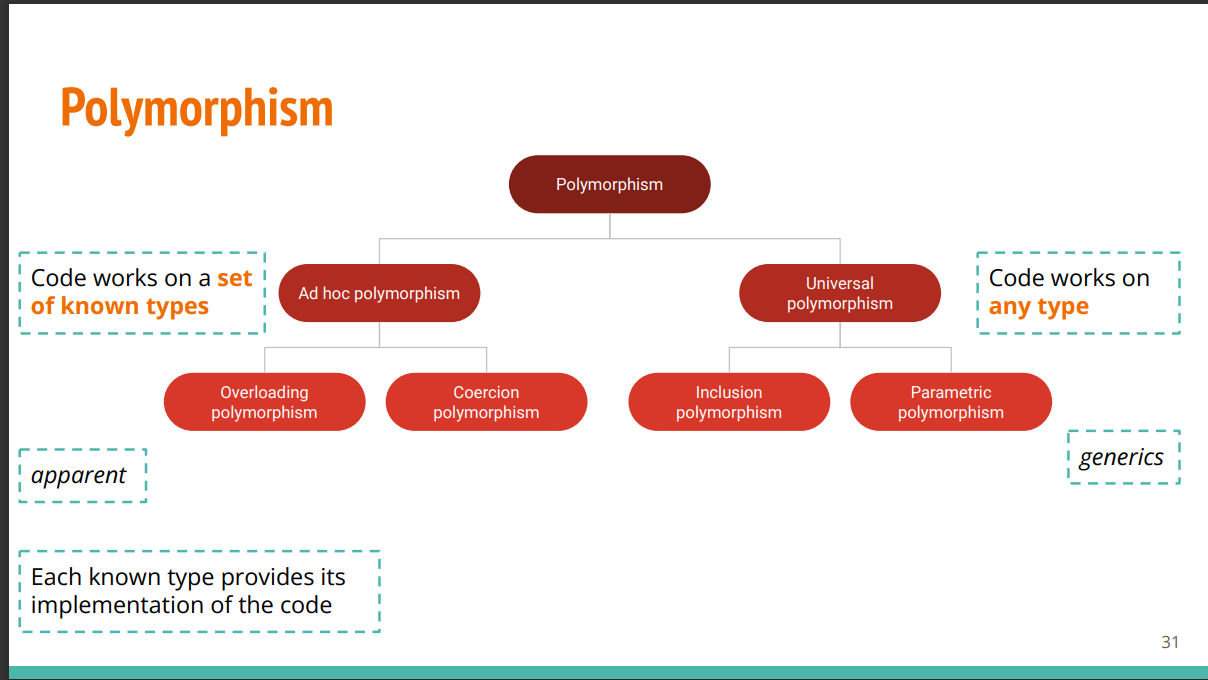
| Polymorphism | Behavior depends on context. Allows for reusability and maintainability. Works for all subtypes, allows implicit conversions, and can be parameterized. |