Exercise 2
Info
We will now study two such algorithms, linear search and binary search.
Note that to use the binary search algorithm we need the list (a1, . . . , an) to be sorted.
a) Implement the two algorithms in the provided file SearchCompare.c.
// procedure: LinearSearch(x: element, (a1, a2 , . . . , an): list)
int i = 0;
/* Fill in your code HERE! */
while (i <= N - 1 && x != array[i]) {
    i++;
}
if (i <= N-1) {
    return i;
} else {
    return -1;
}
// Procedure: BinarySearch(x: element, (a1, a2, . . . , an): list)
int i = 0;
/* Fill in your code HERE */
int j = N;
int m;

while (i < j) {
    m = (i + j) / 2;
    if (x > array[m]) {
        i = m + 1;
    } else {
        j = m;
    }
}
if (x == array[i]) {
    return i;
}else {
    return -1;
}
b) Check if the element 7000 appears in the lists List500.txt, List1000.txt, List2000.txt, List4000.txt, and List9000.txt.
Info
The code provided runs each algorithm 1 Million times and measures the time they take.
7000 does not exist in any of the lists, which means we can use it as a benchmark for the different Algorithms at their worst performance.
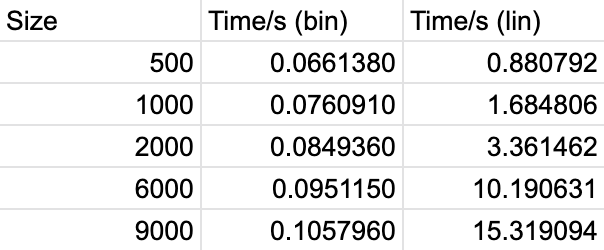
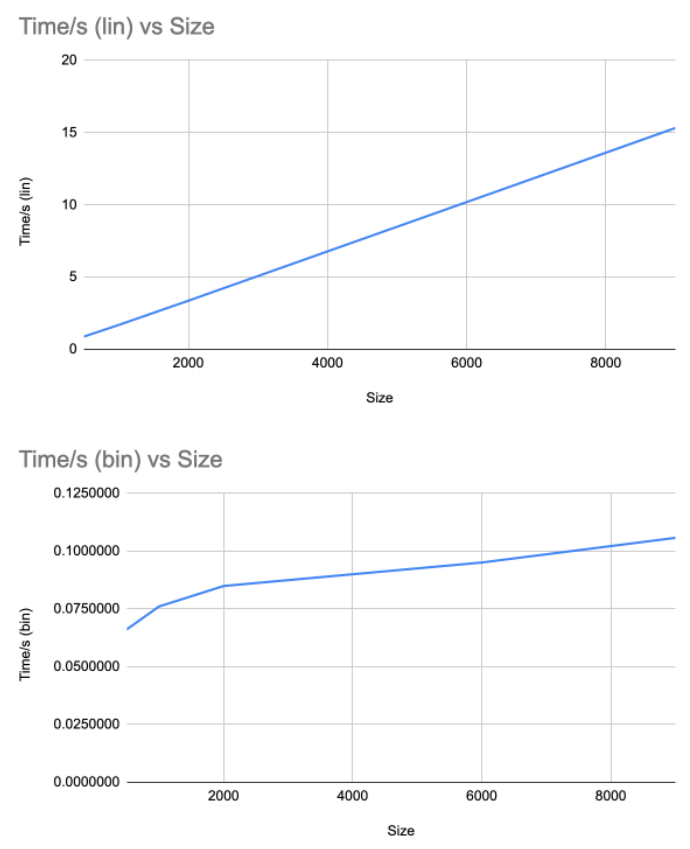
c) Take note of how long the algorithms take for the different lists and plot list size on the x-axis and the time it took on the y-axis
Binary search is faster than linear search because it uses the ordered nature of our data, to eliminate half of the remaining elements as a possible solution each time, reducing the number of comparisons needed to find an element, from O(n) to O(log n) which makes it faster for large arrays.
 { align=center }
 { align=center }